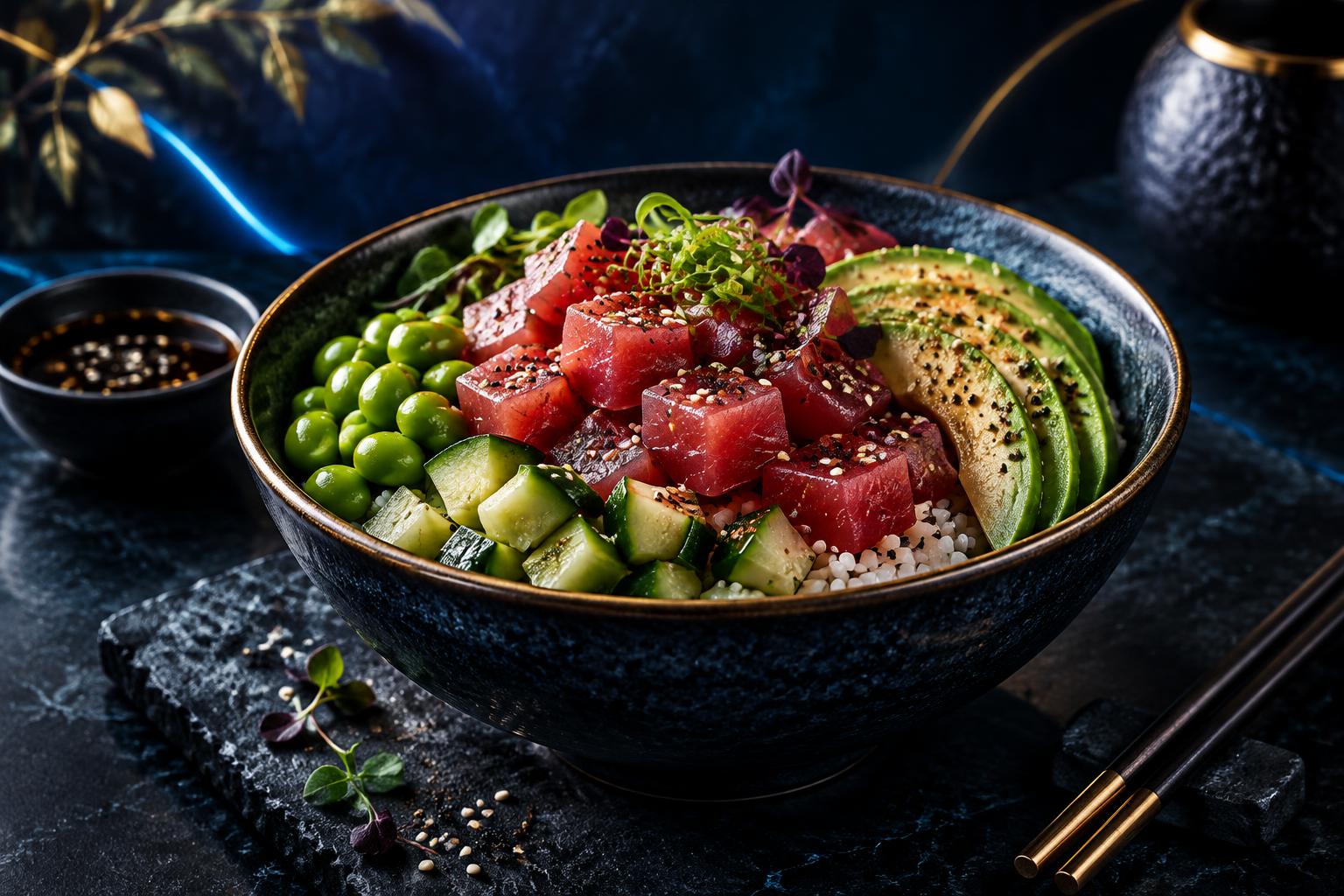
Explore how PokeBowl.si could become a distinctive digital brand for restaurants, delivery, recipes, food commerce, healthy dining and emerging restaurant technology.
A Category Consumers Already Understand
Some of the strongest digital brands begin with something consumers already understand. "Poke bowl" is one of those terms.
Poke — diced raw fish seasoned and served over rice with vegetables, sauces and toppings — has roots in Hawaiian cuisine, where seasoned raw fish has been prepared and enjoyed for generations. In its contemporary restaurant form, the poke bowl traveled from Hawaii to the mainland United States and then to cities around the world, becoming one of the most recognizable categories in fast-casual dining. Dedicated poke restaurants opened by the hundreds, grocery stores added poke counters, and the word itself entered the everyday vocabulary of lunch.
That journey matters for branding. When a food becomes a category, the category name becomes commercially meaningful. Diners do not need "poke bowl" explained to them; they search for it, order it and recommend it. A digital identity built directly on the category term starts with that recognition already in place.
The Modern Food Business Is a Digital Business
Restaurants and food brands increasingly live as much on screens as on the street. A contemporary food business may combine physical locations with mobile ordering, third-party and first-party delivery, loyalty programs, subscription offerings, e-commerce for packaged goods, recipe and video content, social media, meal-planning tools, restaurant discovery features, personalization and AI-assisted recommendations.
Each of those channels benefits from a name that is short, clear and easy to type, say and remember. A customer who sees a delivery bag, hears a podcast mention or scrolls past a social post should be able to find the brand again without effort. Category-focused names have a natural advantage here: the name itself communicates what the business is about before a single line of marketing copy is read.
This is as true for a single neighborhood restaurant as it is for a national platform. The difference is scale — and a category name leaves room for either, from a first location to a national platform.
What Could Be Built on PokeBowl.si
Because poke is both a dish and a category, the name could support a wide range of ventures. The concepts below are possibilities, not predictions; their value would depend entirely on the business built behind them.
A Restaurant or Franchise Brand
The most direct application is a poke restaurant concept — a flagship location, a fast-casual chain, a franchise system or a delivery-first kitchen operating under one memorable identity. The name works equally well on a storefront, a menu and an app icon.
An Online Ordering Platform
A dedicated ordering and delivery platform could let customers build custom bowls — base, protein, toppings, sauces — save favorites and reorder in a few taps. Loyalty rewards and subscriptions for regular customers could live under the same roof.
A National Poke Restaurant Directory
A searchable directory of poke restaurants by city, with reviews, menus and photos, could serve diners traveling or exploring their own neighborhoods. Restaurant discovery remains one of the most active categories in consumer food media.
A Recipe and Food-Content Destination
Poke is naturally photogenic and endlessly customizable, which makes it ideal for content. A recipe destination could publish bowl-building guides, sourcing tips for quality fish, sauce recipes and video tutorials, growing an audience that later supports products or partnerships.
A Premium Seafood Marketplace
Because poke begins with quality raw fish, the name could extend to a seafood marketplace connecting consumers and restaurants with trusted suppliers, with an emphasis on sourcing transparency and freshness.
Healthy Eating and Meal Kits
Poke bowls align naturally with health-conscious dining: lean protein, vegetables and customizable portions. A healthy-eating platform or a meal-kit service — pre-portioned fish, rice, vegetables and sauces for poke night at home — is one of the more intuitive extensions of the category.
Personalization and AI-Powered Dining
A technology-driven concept could use AI-assisted recommendations to suggest bowl combinations based on a diner's tastes, dietary preferences or past orders, or to help a diner discover a highly rated poke restaurant nearby. Food businesses exploring the restaurant-technology side may also find natural synergy with concepts like DineSmart.si, while a premium-protein angle could pair with names such as Steaks.si. These are possibilities; their value would depend on data quality, user trust and careful execution.
Memorable Branding in a Crowded Marketplace
The restaurant and food-delivery marketplace is crowded. Delivery apps list thousands of near-identical options, and consumers make decisions in seconds. In that environment, a memorable digital identity does real work: it shortens the distance between seeing a name and remembering it, between hearing a recommendation and typing it in.
Consider how a diner actually behaves. A coworker mentions a great poke place; a delivery bag crosses an elevator; a thirty-second video shows a bowl being assembled. In each case, the customer's next step is to find the brand again — in a search bar, a map or an app store. A name that is itself the search term removes every layer of friction from that moment. There is nothing to misremember and nothing to misspell.
Category-focused names carry a second advantage. They age well. Individual menu trends come and go, but a name tied to an established food category can support a business through menu changes, new locations, new products and new channels. The name becomes a container the brand fills over time — much as fellow food-category identities like Fajitas.si illustrate from the Tex-Mex side.
Finally, clarity compounds across every channel a modern food business uses. Packaging, social handles, loyalty apps, podcast ads and storefront signage all draw from the same short name, and each exposure reinforces the others. That consistency is difficult to buy with advertising alone, and it is one reason intuitive category names have historically anchored durable consumer brands.
Why PokeBowl.si?
POKEBOWL.SI
The case for the name rests on simplicity. An established food category sits directly before the dot: eight letters, two words people already use together, no hyphens, no numbers. It is easy to say aloud, easy to spell when heard, and easy to fit on a bowl, a bag, a storefront or a phone screen.
It is also worth being precise about the extension. .SI is officially the country-code top-level domain for Slovenia. Some entrepreneurs and investors creatively read "SI" as shorthand for ideas such as Smart Intelligence or Superintelligence; that is a creative, future-facing branding interpretation only — not the official meaning of the extension, and .SI is not officially an AI extension. Here, the extension simply provides a short, distinctive ending to a name that explains itself.
The Convergence of Food, Commerce, Data and Technology
Food, commerce, data and intelligent technology are converging. Ordering is increasingly personalized, menus are increasingly dynamic, and the distance between content and commerce — seeing a dish and tasting it — keeps shrinking. The food businesses of the next decade will be built by operators who treat their digital identity as seriously as their recipes.
A short, category-defining name is a foundation for that kind of venture. It will not cook the fish or earn the reviews — the business has to do that — but it can make every first impression easier, every recommendation easier to pass along, and every menu, bag and app icon a small piece of marketing that works on its own.
PokeBowl.si Available for acquisition: $19,888
Visit the PokeBowl.si listing page to explore acquiring it through Spaceship or contact Omni World Media with questions, or browse the full domain portfolio and more Insights. No representation is made regarding the future value, traffic or performance of any domain; buyers should conduct their own due diligence, including trademark review for their intended use.